
Blog
Visiting the Panama Canal – Amateur Traveler

The Atlantic Ocean entrance to the Panama Canal, showing both the Gatun and the Agua Clara Locks
Our cruise ship was in the midst of completing a partial transit of the Panama Canal on the morning of Friday, December 26th. This was a journey I had longed to embark upon since my teenage years. We commenced our approach from the Atlantic Ocean at 6:00 am, coinciding with the sunrise above the horizon. I had chosen a cabin on the port (left) side of the ship, which I thought would provide an ideal view of the operations. Unfortunately, in the early morning, the sun streamed directly into our room, while the activities outside remained shrouded in darkness. I was forced to keep the shade drawn as the low morning sunlight was blinding us and obstructing our view of anything outside our cabin.
Due to the intense sunlight, our ability to see the canal was significantly hindered. We had a general awareness of the events occurring outside, yet the views from the ship were unimpressive. The side of the vessel we were on was too dark for photography, and the scarcity of observation areas at the front of the ship was even more disappointing. Passengers in the premium cabins situated above and at the front had access to private viewing spaces.
Additionally, exclusive areas at the front of the boat could be purchased for a substantial extra fee. The only forward viewing point I found was from the gym on the 15th deck, which was packed with spectators. All of this felt rather unjust. We could watch the operations on the television in our cabin, with commentary from the bridge, but it felt like watching a YouTube video.

The forward video view of the Agua Clara Locks displayed on televisions throughout the Celebrity Ascent
Expectations
I traveled to the Panama Canal with high hopes for an exhilarating adventure; however, at this moment, the entire experience felt sluggish and lacking in excitement. I remembered my visit to the Three Gorges Dam during a riverboat cruise on the Yangtze River, where we enjoyed meals as our boat maneuvered through towering concrete structures and descended a considerable height through five successive locks. The drama of that experience remains etched in my memory!
My fellow travelers also recounted their experiences with the many locks they encountered on European river cruises, sharing their amazement at those instances. Yet, as I found myself at the famous Panama Canal, moving through the locks, I couldn’t help but wonder, “Is this all there is?”
As a former elementary school educator, one of the most engaging subjects I presented to my students was the engineering marvels of the world. At the forefront of that list was invariably the Panama Canal. The human endeavor and engineering expertise required to establish a route between the Atlantic and Pacific Oceans through Panama’s diverse landscape represented a significant accomplishment for humanity in the early 1900s.
I nostalgically recall discussing with students the obstacles encountered during the canal’s construction and the narratives of how countless individuals perished while laboring under the arduous conditions of the Panamanian climate and jungle. Despite sharing photographs, videos, and documentaries about the canal with my students, I had never had the opportunity to see it firsthand.
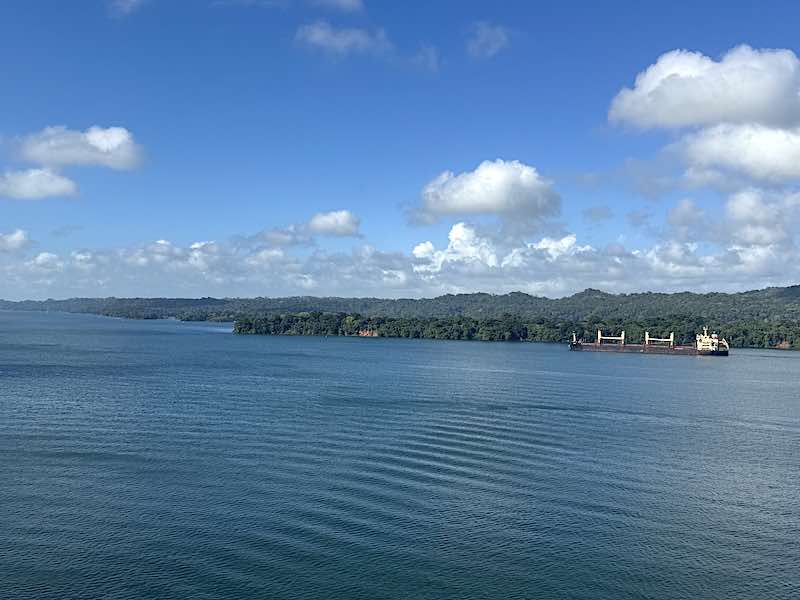
Gatun Lake as seen from the Celebrity Ascent
My chance to explore the canal occurred during a cruise ship journey that involved a partial transit of the system. The partial transit of the Panama Canal is a popular cruise itinerary that typically begins in Florida or a Caribbean port and enters the canal from the Atlantic side. Once the ship passes through the locks on the Atlantic side, it turns around in Gatun Lake and then exits back into the Atlantic Ocean. The cruise aims to give passengers a sense of what it is like for a vessel to navigate through some of the canal’s locks.
Partial transits are intended to provide travelers with the distinctive experience of the Panama Canal while also allowing them to return to their original port of embarkation. Typically, partial transit cruises include stops at Cartagena and the ABC islands, which consist of Aruba, Bonaire, and Curacao. These cruises generally last 10 to 12 days, with just one day dedicated to the Panama Canal; however, the Panama Canal is usually the focal point of the itinerary.
This is significantly different from a complete transit of the Panama Canal, where a vessel enters from one ocean, navigates the entire canal system, and arrives at another ocean on the opposite side of Panama. Complete transits typically occur on cruise ships when cruise lines relocate their vessels to itineraries across different seasons of the year.
One of the most sought-after repositioning experiences occurs when cruise lines transport ships from the Caribbean through the Panama Canal to offer summer excursions to Alaska. Complete transits of the Panama Canal enable ships that usually operate in the Caribbean during the North American winter to circumvent hurricane season and capitalize on the Alaskan summer.
Origin of the Canal
Even though the story of the Panama Canal dates back over a century, it is still a big deal today. The Spanish conquistador Vasco Núñez de Balboa, who crossed the isthmus in 1513, is often credited with identifying the potential for a navigable route through Panama. This recognition prompted Spain’s Emperor Charles V to commission an inaugural survey in 1534. The California Gold Rush of 1849 heightened the urgency to find a more direct and safer route between the Atlantic and Pacific Oceans, leading to the establishment of the Panama Railroad.
Sailors and nations envisioned the advantages of a maritime passage; however, it was not until the French completed the Suez Canal in 1869 that this aspiration became more attainable. Shortly after the Suez Canal’s successful inauguration, the French shifted their focus to constructing a canal through Panama in 1880. The Compagnie Universelle du Canal Interocéanique (Universal Interoceanic Canal Company) was formed, and the French canal engineer, Ferdinand de Lesseps, proposed a sea-level canal design for Panama. Unfortunately, the initial undertaking was short-lived and was ultimately suspended due to severe working conditions and the daunting realities of the project’s scale.

Political Cartoon – Theodore Roosevelt builds the Panama Canal— and shovels dirt on Colombia.
The U.S. Finishes the Canal
In the early 1900s, the United States undertook the construction of the canal, spearheaded by then-President Theodore Roosevelt. The Americans tackled the obstacles by designing a system of locks to raise and lower ships. Their design capitalized on the natural lakes in Panama and recognized the engineering challenges that needed to be addressed, including the Culebra Cut through Panama’s mountainous region. The American construction team also acknowledged the difficulties posed by diseases and the tropical climate. Their initial actions focused on controlling the mosquitoes that spread malaria and yellow fever. By overcoming both engineering and construction challenges, the Americans successfully completed the canal in 8 years, revolutionizing travel from the Atlantic to the Pacific Ocean.
History classes in the United States celebrate the construction of the canal, which has gained a legendary reputation over the years. It is frequently recognized as one of the world’s seven modern engineering marvels. My desire to witness this significant human accomplishment motivated me to book a partial transit cruise. I aimed to experience this engineering wonder and comprehend the reasons behind the canal’s uniqueness. Traveling on a cruise ship appeared to be an excellent method to achieve this. It promised comfort, and I hoped a partial transit would provide me with a clear understanding of the canal’s appearance and the nature of the experience.

The Celebrity Ascent snuggly fitting into the Agua Clara Locks
The New Panama Canal Locks
Many people are unaware that the canal has had some changes over the years. Channels have been widened, and new protocols are constantly updated to make the transit safer and more efficient. When the canal was originally finished in 1914, ships were smaller than they are today. The large container ships used today are too large to fit through the original canal locks, so transport was limited to ships that met the locks’ size requirements. In the early 2000s, Panama undertook the task of installing new locks at each end of the canal to accommodate larger ships.

A ship making transit through the Gatun Locks of the Panama Canal
The original 1914 Gatun Locks are still in use, and ships that can fit through them still transit the original system. Larger ships use a new set of locks that are parallel to the old ones and separated by about half a mile. The new locks function differently and use less water and power than the original locks. In addition, the new locks allow only one-way passage, whereas the original locks were a parallel set that allowed ships to enter and exit simultaneously. My ship was scheduled to transit through the new Agua Clara Locks.

The Agua Clara Lock system viewed from Gatun Lake, looking towards the Atlantic Ocean
Our Cruise
The cruise line we traveled with was Celebrity. We frequently seek out unique and diverse cruise itineraries, and Celebrity was offering an 11-day cruise that included stops in Cartagena, Aruba, Bonaire, and Curaçao, and featured a partial transit of the Panama Canal. Additionally, the cruise took place during the Christmas and New Year’s holidays. We reserved this cruise approximately 18 months in advance and selected a balcony room on the port (left) side of the vessel.
The ship for this voyage was the Ascent, a relatively new cruise ship that was launched in 2024. Rather than traditional balcony rooms, it provided cabins with an infinite-view balcony, which resembled having a small lanai attached to our stateroom, complete with a large window that could be lowered to create the sensation of having an oceanside balcony. We believed this would enhance our experience while viewing the transit through the canal.
From the outset of our journey, it was clear that the Captain and Cruise Director were prioritizing the Panama Canal experience as the main highlight of the cruise, even though it came early in our 11-day itinerary. The staff excelled in hosting presentations in the main theater, covering subjects such as the canal’s history, the canal zone, and the history of the surrounding area.
Additionally, the captain delivered a special presentation discussing the difficulties of navigating the locks and maneuvering a large cruise ship in and out of the canal. I participated in numerous programs and can confirm that the theater was filled to capacity each time.
The cruise included a narrator who shared insights at each stage of our journey into the canal. This narration was broadcast throughout the ship, and Channel One on the cabin televisions featured it alongside a live camera feed from the front of the ship. According to the published schedule, we were set to approach the canal at 6:00 am. We would enter the first lock at 7:30, followed by two additional locks every half hour. By 9:00 am, the ship was expected to enter Gatun Lake, where it would remain until later in the afternoon, when it would exit through the same locks and dock in the city of Colon.

The Celebrity Ascent in Gatun Lake as seen from the Agua Clara Locks Visitor Center
Shore Excursions
Cruise passengers had the option to either remain on the ship and enjoy the transit in both directions or choose from a variety of excursions once the ship had entered the canal and was anchored in Gatun Lake. Passengers would take tenders to the nearby shore, where buses awaited them. A range of tours was available, showcasing nature experiences such as an Eco cruise on Gatun Lake, a wildlife cruise on the lake, kayaking, canoeing to a native village, and an aerial tram ride through Panama’s tropical rainforest.
We decided to disembark the ship and take a bus tour of the Agua Clara Locks, the Panama Canal Visitor Center, and Old Panama City. Our rationale was to maximize our exposure to the canal and Panama. Our 6-hour tour would transport us from the Atlantic to the Pacific in under an hour. Our excursion would give us the opportunity to see the other entrance to the canal on the Pacific Ocean and immerse ourselves in Panama’s culture and heritage. At the conclusion of our tour, we would rejoin the ship on the Atlantic side of the canal at the Port of Colon.

A central plaza in Old Panama City
Navigating the New Locks
From our balcony, I observed the canal as best as I could as it passed through the initial two locks. Despite its remarkable engineering, the canal was not much to look at. It didn’t have that “Wow” factor like Hoover Dam or the Golden Gate Bridge. The constructed area of the canal is a slender waterway surrounded by numerous low-rise buildings. Unlike the previous version, the new canal does not use electric “mule” trains to move ships along its length. Instead, boats are self-propelled and assisted by tugboats. Workers, equipped with ropes attached to the vessels, accompany the large ships along the banks in case they need to be quickly secured and stabilized.
The procedure is gradual, and vessels do not ascend a significant height in the locks. The cumulative elevation increase across all three locks is merely 85 feet (26 m). The first two locks raise the vessels by approximately 27 feet each, while the final lock raises them by about 30 feet. This occurs at a slow pace, rendering the ascent hardly perceptible. The lock doors slide open from the side, differing from the traditional opening and closing mechanism of the original canal locks.
Additionally, the new canal locks are designed with only a single lane. Specific times are allocated solely for morning entry and later-day exit. It is a tranquil, systematic procedure, ideally devoid of any complications.
As we navigated the locks, I realized there wasn’t much to experience.
My group of travel companions opted to head to the ship’s buffet for breakfast while we traversed the remaining lock. There was little to observe, and nothing particularly dramatic seemed to be occurring. I was unable to capture decent photographs, and it felt anticlimactic to view it on the cabin television. While enjoying breakfast and discussing the events, I had a clear view of the outside since we were on the 14th deck. The ship had successfully passed through the final lock, and we were conversing about our forthcoming excursion.

The Celebrity Ascent parked in Gatun Lake after passing through the Agua Clara Lock system
Leaving the Locks
At that moment, I noticed the ship veering to the right. I also accurately surmised that a different angle might offer a chance to capture a distinctive perspective on the operation. By turning immediately after leaving the last lock, the ship aligned itself perpendicularly to the canal locks. This created remarkable opportunities to photograph both the new and original locks as well as the approach from the Atlantic Ocean. I also noted that no one aboard the ship appeared to be aware of this. I realized I needed to act quickly, so I informed my travel companions that I was stepping outside to take some photographs. I didn’t even have the opportunity to elaborate on what I felt was about to occur.
In approximately 15 minutes, the ship executed a right-hand turn, allowing passengers to capture images of both the new and original locks from the upper tier. I hurried to the highest vantage point and found the railings unobstructed by glass. I was astonished to find that no one else was present.
Within that same 15-minute window, I successfully obtained the photographs I had been eager to take. It was a remarkable moment of serendipity that set the stage for the next phase of the experience. My earlier morning disappointment swiftly faded, and I began to understand that the canal experience I had been anticipating was just beginning.

The author at the Agua Clara Locks Visitor Center
Shore Excursion to the Locks
Ultimately, our vessel, now in Gatun Lake, navigated between the new and old locks to prepare to tender excursion passengers ashore. We made arrangements for our six-hour tour. Approximately 1,200 passengers chose to participate in a day tour, while the remaining 2,000 passengers remained aboard the ship to witness its return passage through the locks to the Atlantic Ocean later that afternoon. Following a brief tender ride, we boarded buses for a swift tour of the original Gatun Locks and the adjacent Agua Clara Locks Visitor Center.
The visit to the original locks was underwhelming as we did not pause for photographs. A Viking cruise ship was departing the final lock into Gatun Lake, yet we were unable to view the exit locks or any of the operations. We saw a few of the electric trains called “mules” that pull ships through the locks, but they were behind fencing, making them difficult to see and impossible to photograph. Disappointingly, we primarily viewed the original canal buildings rather than the canal itself.

The Agua Clara Locks Visitor Center viewing platform
The roadway leading to the Agua Clara Locks Visitor Center was constructed over one of the newly installed lock gates. As a ship was departing the locks, we were required to wait approximately 45 minutes for it to pass. Following a brief drive to the opposite side, we ascended a hill to gain a comprehensive view of the lock system. The vistas were breathtaking! We could observe our ship anchored in Gatun Lake, along with a glimpse of the original Gatun Locks in the distance. The highlight was the unobstructed view of the new Agua Clara Lock system, where we saw a container ship navigate through the locks toward the Atlantic Ocean. We also saw the tugboats in operation, positioning the vessels, and observed the rolling lock gates opening and closing.

A sliding gate used to seal a lock entrance after a ship has entered a lock
By observing the process in real time, we gained insight into the entire systematic canal transit system that we had navigated. A film was shown at the Visitor’s Center that detailed the process, but we found that witnessing it firsthand was significantly more engaging.
Additionally, we saw how the innovative water-saving basin system captures and recycles approximately 60% of the water used to operate the locks. We spent a full hour here, appreciating the scenery and watching a vessel navigate the canal.
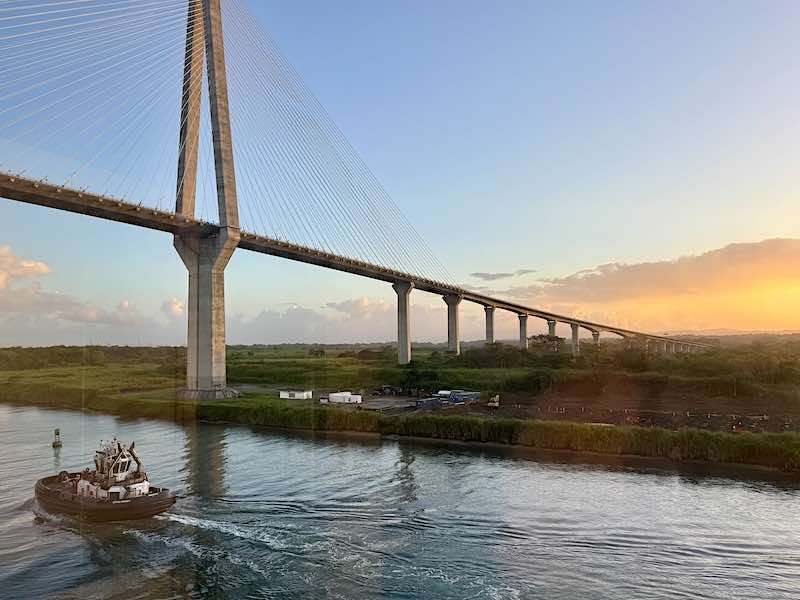
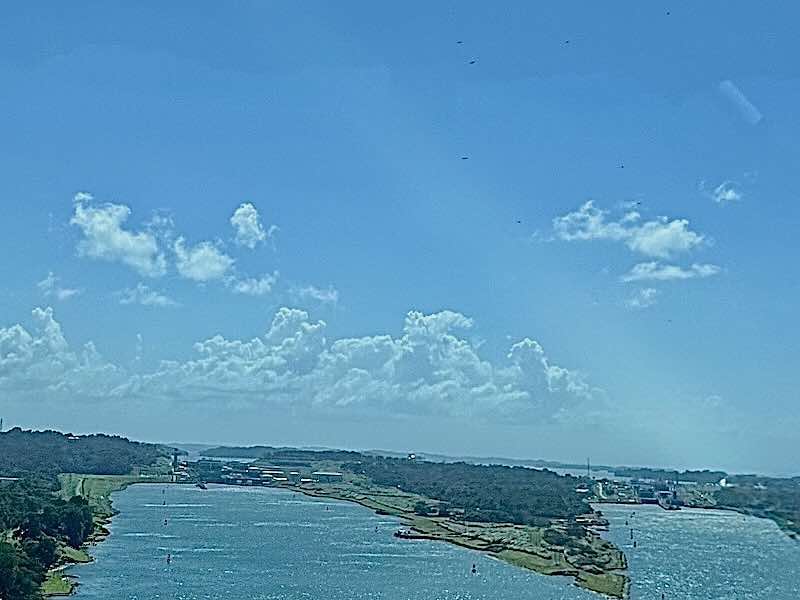
The Atlantic Bridge crossing over the Panama Canal
Views from the Atlantic Bridge
Our next destination was the Atlantic Bridge spanning the Panama Canal. We questioned the reason for driving over the bridge, as it seemed inconsistent with our planned itinerary. However, once we began our ascent, we understood that the bridge offered an exceptional view of both the original and new canal locks from the Atlantic Ocean entrance. Despite the morning haze, the view was still remarkable and one we could not experience from our ship, given the early hour and the limited viewing areas on board.

Puerto Balboa, the Pacific Ocean entrance area to the Panama Canal
The City of Balboa
We then took an hour-long ride to Panama City. Our journey began with a visit to Balboa, where we explored the original site of the Panama Canal Authority’s administrative buildings. This area featured several parks and monuments that commemorated the construction of the canal and the notable individuals who spearheaded the effort.
While some of the structures appeared to require significant updates and repairs, many had been restored to their original condition and were actively utilized by various agencies. Following this, we proceeded to the Port of Balboa region to observe the Miraflores Locks and the Pacific entrance to the canal. Regrettably, we were unable to view the new Cocolí Locks. In the distance, we could see the Bridge of the Americas and the path that vessels took to navigate towards the Pacific entrance of the canal.
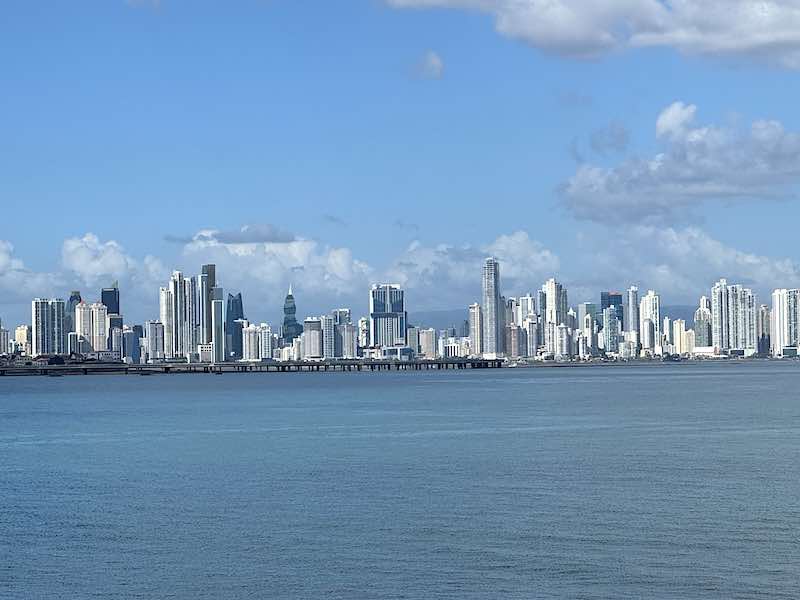
The city skyline of Panama City
Old Panama City
Our journey along the Amador Causeway, adjacent to Puerto Balboa, allowed us to see the Frank Gehry-designed BioMuseum and the waterfront entertainment district. In the background, we could also see numerous tall apartment buildings in Panama City. Our destination was Old Panama City. Following a short walking tour, we spent some time unwinding in the Old City. This area featured historic churches, colonial architecture, and various establishments for dining and enjoying a beverage.
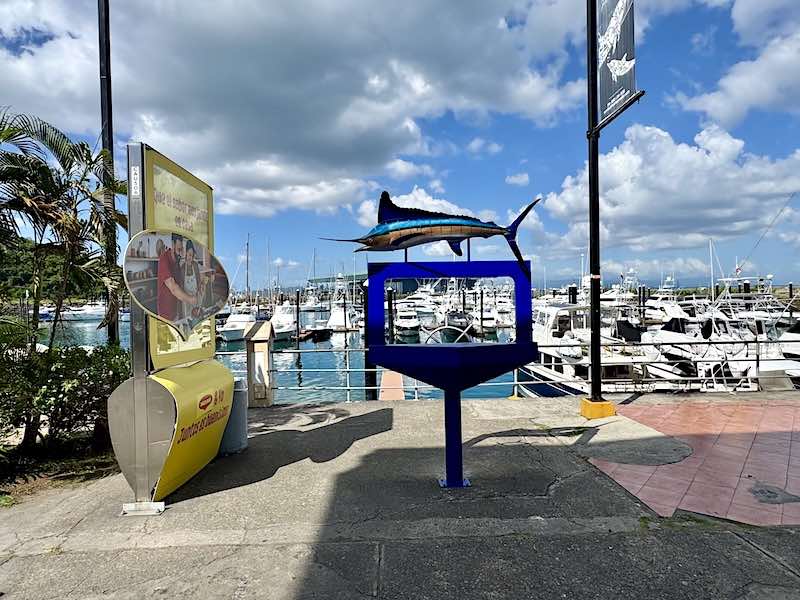
The waterfront entertainment district of Panama City, located at the end of the Amador Causeway
A notable feature in this region is the Museo del Canal Interoceánico de Panamá (Panama Canal Museum). Founded in 1997, the museum focuses on the history of the Panama Canal’s construction through its various phases, beginning with the initial French efforts, followed by the later work undertaken by the United States, and culminating in the eventual handover to Panamanian authority.

Parks along the water at the entrance to Old Panama City

A gazeba in the center of Old Panama City
Exploring Old Panama City offered a wonderful chance to witness residents celebrating the day after Christmas. As evening approached, we made our way back to Colon, a journey of an hour, to rendezvous with our ship at the cruise port. Overall, it was a day filled with activity and excitement.

Vendors selling crafts in Old Panama City
What to Know
My desire to experience the canal served as my main reason for booking this cruise. I held high hopes of reliving some of the thrill of the canal’s original construction. Unfortunately, I did not encounter much of that. I also anticipated being impressed by the experience, yet I found myself largely underwhelmed during the early stages of our journey through the canal. It differed from my expectations, primarily because it was difficult to observe what was happening aboard the ship. After entering the canal, I took a moment to reflect and realized there was additional information I wished I had had in advance, which might have enhanced the overall experience.

A view from the first Atlantic-level Agua Clara Lock looking towards the Atlantic Ocean
It would have been preferable to reserve a cabin on the starboard (right) side of the vessel for the canal transit from the Atlantic Ocean in the early morning. While this may not have been the most advantageous room location for docking at the other ports on the cruise, it offered the best view of the canal entrance during our early-morning journey. Additionally, the starboard side afforded an excellent view of the Gatun Locks.

A view of a ship entering the Gatun Locks from Gatun Lake
I highly advise anyone considering a partial transit of the canal to research the ship they are on to learn from the experiences of past cruisers. This research could help you pinpoint the best viewing locations, or it may reveal that few viewing areas are available to most passengers without incurring extra fees.
Additionally, it is wise to explore different cruise itineraries, as some cruise lines might provide more captivating opportunities. The passengers aboard the Viking cruise ship we observed likely navigated the original Gatun Locks and had the opportunity to view the new Agua Clara Locks from the Visitor Center. That would have provided them a full and engaging canal experience.
I believe that our choice to reserve a tour from the ship to explore Panama was an excellent decision. Had we not undertaken this, we would have overlooked the most stunning views of the canal from the Agua Clara Locks Visitor Center.
Additionally, we discovered that our exploration of Panama was immensely fulfilling and constituted the highlight of our experience. It was fascinating to observe the original administrative offices in Balboa, along with the operations on the Pacific side of the canal. Conversations with fellow travelers who participated in nature excursions around Gatun Lake also indicated that they found their experiences to be highly rewarding.
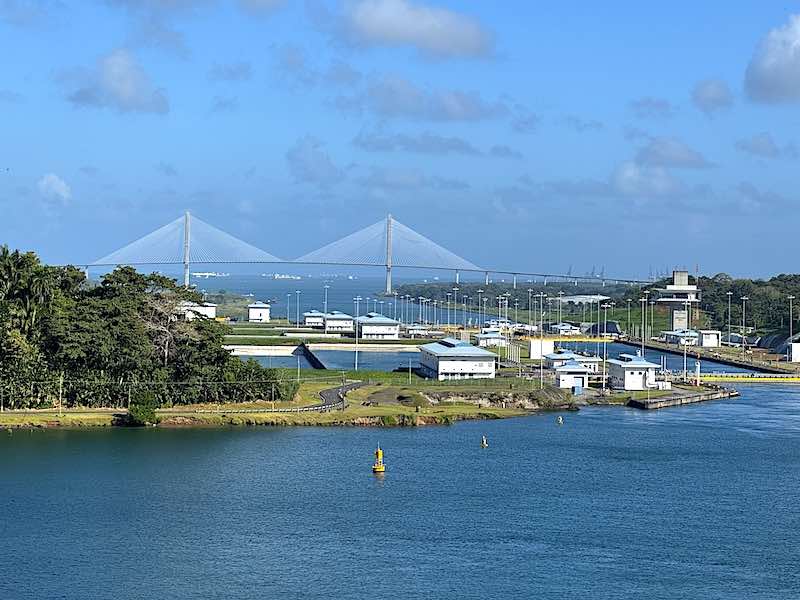
The Atlantic Bridge as seen from the Agua Clara Lock system
Conclusion
If you genuinely wish to experience the Panama Canal, it is advisable to book a complete passage through the canal. A partial transit is a secondary option; however, it is crucial to conduct thorough research and consider what you want to experience to make appropriate plans. Merely remaining on the ship and entering and exiting the canal may not yield a highly rewarding experience.
By positioning yourself in the right locations and comprehending what you are witnessing, you will enhance your overall appreciation of the experience. Additionally, it is beneficial to utilize your time in Panama to explore the country or the natural surroundings of the Canal Zone. I found these experiences just as fulfilling as the canal itself.

I felt that I had satisfied my curiosity regarding the Panama Canal. What I took away was a strong desire to further explore northern South America and Central America. For me, this is the essence of travel. Whenever I visit a renowned location, I ultimately discover new, thrilling experiences that I was previously unaware of.
If you are considering a cruise to experience the Panama Canal, understand that the journey encompasses much more than merely the canal itself. It offers a chance to witness a remarkable engineering achievement and to gain insight into the region’s people and culture.