
Blog
Travel to Southeastern China (Xiamen, Fujian, and Guangzhou) – Episode 990

Hear about travel to Southeastern China as the Amateur Traveler talks to Jonty Crane from JontyTravels.com about his first trip to China, to a less-visited region.
Why should you visit Southeastern China?
Jonty says, “China is a unique country, with a fascinating history, and interesting sights, and these three areas discussed have seemingly almost no Western visitors despite only being half a day’s travel from Hong Kong.”
Jonty visited over the New Year 2025 from Hong Kong. Visiting China isn’t quite as simple as visiting other countries. We cover what you need to know in this episode.
Itinerary
One week, two days in Xiamen, two days in Fujian Tulou, and two days in Guangzhou, plus two half days on trains.
Brief history
Xiamen and Guangzhou (then known as Canton) were two of the first cities in China to open to foreigners as part of the Treaty of Nanking in 1842 (along with Fuzhou, Ningbo, and Shanghai) which followed the first Opium War, in which the British deployed gunboat diplomacy to open the country to trade, as the US did with Japan a decade later.
In 1980 Xiamen was one of the first four special economic zones, and Guangzhou became one in 1984, after which they experienced huge growth.
Itinerary details
Xiamen
Xiamen is the 25th largest city in China, home to around 5.5 million people (similar to New Zealand), and is on China’s southeast coast.
- Xiamen Botanical Gardens – needs at least half a day. These are huge gardens, including multiple temples with names like Banling Earth God’s Temple and The Eternal Peace Rock Temple
- Eighth Seafood Market Bashi – huge variety of seafood, dead and alive!
- Nanputuo Temple – dates back to 1684, the best known temple in Xiamen, busy but quite impressive
- Hulishan Fortress – built at the end of the 19th century as part of China’s Self-Strengthening Movement. It defended Xiamen during conflicts, including the First Sino-Japanese War and the Boxer Rebellion. It is known for the huge 14m long Krupp cannon, which saw action before the city fell to the Japanese in 1938.
- Overseas Chinese Museum, which details the life of Chinese living overseas
- Gulangyu Island
- One of the most popular tourist sites in China, Gulangyu Island, attracts over 10 million visitors a year (almost all domestic). Since 2017, the 1.88-square-km island in Xiamen has been a UNESCO World Heritage Site for its dozens of historic buildings dating to the 18th and 19th centuries. Gulangyu and Shanghai had the only International Settlements in China, with 13 countries (mainly European plus Japan) having a presence.
- It can only be reached by boat, with regular ferries leaving from the Dongdu Ferry Terminal for a scenic half-hour cruise through Xiamen harbor, offering great views of the skyline.
- Cars and bicycles are banned from the island, though there are large electric golf cart-type buses that run around the perimeter of the island. It isn’t that quiet, though, as there are literally thousands of tourists everywhere, even at a quiet time of the year.
- There are lots of attractive heritage buildings that wouldn’t look out of place in European cities but are a novelty in China.
- Gulangyu is also home to some of the best beaches in China, though there isn’t much competition. It was interesting seeing how the Chinese respond to beaches.
- Jonty’s favorite place on the island was the beautiful Shuzhuang Garden, built in 1913 by a wealthy Taiwanese businessman. Taiwan is only 280 km away, across the Taiwan Strait.
- Next to the garden is the only Piano Museum in China, along with a sister museum devoted to musical organs. The island is renowned for classical music and has produced several famous classical musicians.
- Sunlight Rock is known far more for its views than the colorful 16th-century Buddhist temple at its base.
Fujian
Fujian is the province, home to Xiamen, Tulou areas are in the southwest
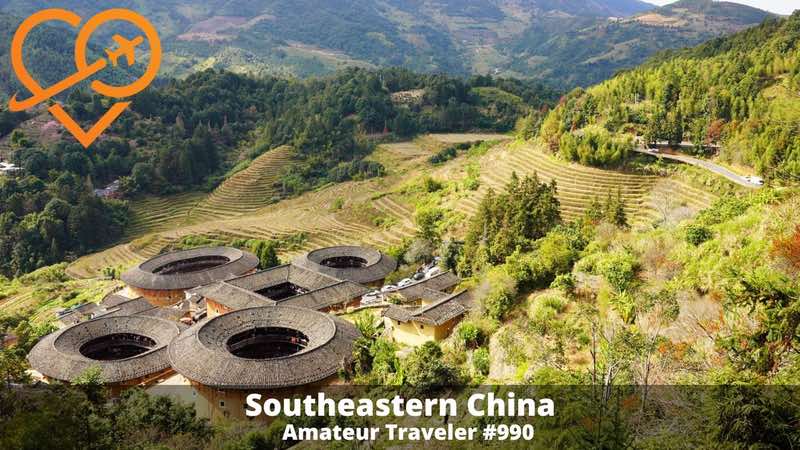
Of China’s 60 UNESCO World Cultural Heritage Sites, Fujian Tulou are among the lesser-known, but they were fascinating places to visit on a two-day tour with China Discovery from Xiamen. Fujian Tulou are unique, massive, fortress-like earthen buildings, typically round, square, or rectangular. Each building is home to a single extended family. They were built by Chinese Hakka people between the 12th and 20th centuries. There are around 80 million Hakka people in China. 46 of the buildings were listed as a UNESCO World Cultural Heritage site in 2008.
- Tianluokeng Tulou Cluster & Yuchang Building – the most famous earthen building cluster known as “Four Dishes and a Soup” with 3 round, 1 oval, and 1 rectangular Tulou buildings, looking like a set meal to the Chinese. They sell expensive ice cream in the shape of the Tulou (and other Chinese landmarks). Outside is very defensive. Inside is more homely, though mainly commercial now, with popular Tulou selling tea, cigarettes, paintings on wood, and food. Tulou are different shapes but always have a shrine dedicated to the ancestors, focused on the original founder of the Tulou, facing the entrance or in the center. Visitors are generally not allowed above the ground floor due to UNESCO, apparently, but if you pay a little, you can usually ascend for better views.
- Yuchang Building – built during 1308-1338. It is the oldest, largest, and highest round Tulou. It has 270 rooms over five stories.
- Taxia Village – lovely, quiet village by a river, mostly pedestrianized. Deyuan Hall is a 400-year-old ancestral hall with elaborate wood carvings and vibrant porcelain mosaics on the roof. Outside the hall are 24 Hakka stone flagpoles, commemorating locals who made significant contributions to the village or lived to 100. Jonty stayed at the Lotus Land hotel on the river, felt Scandinavian inside, and had a wonderful evening wandering around the village. One unexpected sight was the use of green lasers to project images onto the nearby hillside.
- Chuxi Tulou Cluster – known as the “most beautiful Tulou cluster in China”. Jonty spent most of the time in the Jiqing Building, constructed in 1419 with 72 independent units. It was probably the most attractive Tulou, beautifully restored. A number of rooms have been converted into a pretty decent homestay; the place would be atmospheric (if possibly noisy) at night. At the center of the Tulou is a small temple featuring a fake persimmon tree surrounded by artificial wheat, clearly designed for the perfect photo opportunity.
- Hongkeng Tulou Cluster – One of the most popular Tulou places for visitors due to its easy accessibility. Note that there are usually large visitor centers where tickets can be collected. China has impressive tourist infrastructure. The village is home to around 2,400 people. It has an attractive temple near the entrance and waterwheels. Some Tulou buildings are over 600 years old. Some are obviously not (home to a KFC). The Zhencheng Building, also known as the “Prince of Tulou”, is one of the newest traditional Tulou, built in 1912. The Kuiju Building dates from 1834 and, unusually, has an entire house within the Tulou, built for a family member. The final Tulou Jonty visited was the Rusheng Building, which is the smallest Tulou, built between 1875 and 1908. It is only 23m in diameter, but otherwise the same as other Tulou.
Guangzhou
Guangzhou is north west of Hong Kong, home to 18 million people, twice the size of London, one of the largest cities in China, and the world.
- Shamian Island – similar to Gulangyu Island in Xiamen, a small (0.3 square km) island controlled by the British and French from 1859. It is filled with heritage buildings that served as international consulates and European and Japanese trading companies. It is good for people watching.
- Qingping Market Raw Material For Medicine Wholesale – home to a huge range of exotic ingredients for traditional Chinese medicine.
- Zhujiang New Town – Zhujiang has developed from almost nothing to the modern center of the city over the past twenty years. It is home to the three tallest buildings in the city: Canton Tower (the 5th-tallest freestanding structure in the world), Guangzhou CTF Finance Centre (the 8th-tallest building in the world), and Guangzhou International Finance Center (the 24th-tallest building in the world).
- Guangzhou Museum – a huge building in the New Town, dating from 2010. It had a fairly eclectic collection, including impressive carvings, far less impressive taxidermy, and atmospheric ocean and dinosaur areas, plus temporary exhibitions.
- Guangzhou Opera House – Zaha Hadid designed, opened at the same time as the museum
- Nanyue King Museum (Palace Exhibition Area) – 2,200 years ago, the area where Guangzhou lies was controlled by the Nanyue kingdom, which built an impressive palace. The footprint and remains of this can be explored at the moderately interesting museum.
- Nanyue King Museum (King Tomb Exhibition Area) – far more interesting, home to the tomb of Zhao Mo, the second king of the Nanyue.
- Chen Clan Ancestral Hall (Chen Clan Academy) – one of the best-known temples in Guangzhou, and therefore popular.
- City God Temple – a 600-year-old temple, much quieter than the Chen Clan Ancestral Hall, next to the Nanyue King Museum (Palace Exhibition Area)
- Sun Yat-sen Memorial Hall – a grand building opened in 1931 in memory of the founder of the Republic of China and leader of the 1911 Revolution.
- Baiyun Mountain – probably Jonty’s favorite area of Guangzhou. Jonty filled much of a day exploring the multiple gardens and views from the mountain, though at ~400m high, it is more of a hill. The area has been a scenic spot for thousands of years and has been mentioned in historical texts.
- Baiyun Cable Car – judging by the queuing infrastructure can get busy, but it is a great way to get up the mountain to Shanding Square for views of the city
- Yunluo Botanical Garden – beautiful gardens that opened late 2024, similar (if not quite in the same league) to Singapore Botanical Gardens
- Yuntai Garden – 30 years older, and is China’s largest exotic plant garden. This was quite a different experience for a couple of reasons. Firstly, the inevitable public holiday crowds had turned up, with a number in fancy dress for photos. Secondly, it was far more kitsch than Yunluo Botanical Garden, with colorful mascots and folly-type structures dominating. It was worth a quick explore, but wasn’t anywhere near as enjoyable as its neighbor.
Useful Things to Know
- Getting around Cities – Didi is Chinese Uber, works well, and is very cheap. Traffic in Xiamen was busy but manageable; Guangzhou traffic was terrible during the day. Guangzhou has a metro system, but Jonty had trouble getting two people through with one account.
- Getting between cities – four hours by train to Xiamen, a couple of days by private car around Fujian, back to Xiamen, then four hours by train from Xiamen to Guangzhou, and one hour back to Hong Kong. There is a basic selection of food available onboard, but using an app (which never worked for Jonty), you can order ahead from restaurants, which are loaded onto the train at stations and delivered to your seat.
Accommodation – stayed at Hampton by Hilton in Xiamen, good room, close to street with lots of food options, and great city views from restaurant area at the top, in Guangzhou stayed at Fushang Hotel Yuexiu Park (there are two, which Jonty learned the hard way), which wasn’t as flash but well located in older part of city near parks. Neither had receptionists with any English. - Food – a challenge: Chinese food in China is pretty full-on. Translations can be unreliable; beef was actually squid. Xiamen was nearly 100% Chinese restaurants, don’t see the global restaurants of other major cities, and Guangzhou wasn’t much better. If you’re adventurous with food, it’ll be a great adventure. If you just want home comforts, or even just food resembling others you’ve had, it is much more challenging
- Logistics – China’s high-speed train network is excellent, but bookings open only 15 days before travel and can sell out quickly, so a local agent can help (China Discovery did ours). Carry your passport at all times, as it serves as your train ticket and is required to enter many tourist sites.
- Safety – felt very safe at all times, one benefit of an autocratic state with heavy surveillance is low crime levels
- Facilities – plenty of clean and free toilets at tourist sites, never an issue
- Costs – transport was very affordable, hotels reasonable, attractions relatively cheap, guide and driver for Xiamen & Fujian Tulou Highlights Tour cost US$2,200 for 5 days (though only really a 3-day tour)
- Money – Jonty never used cash in China, paying for everything (restaurants, tourist sites, street food, tipping guides) through the WeChat app, linked to his Wise card, which was loaded with Chinese Yuan. It is worth setting this up at home, though, as it requires a fair amount of setup with your passport and verification texts.
- Language – Almost no one speaks English, so Google Translate is essential.
- Internet – Jonty had understood that Google and Facebook wouldn’t work in China, but using an eSIM, Jonty had no issues accessing either. He did have a lot of issues with Wi-Fi in hotels and restaurants, which was unreliable and slow due to the Great Firewall of China. Google Maps is off as it uses a different GPS system, use Amap instead.
- Climate – early January is a perfect time to visit, with blue skies and temperatures 10-22 °C or 50-72 °F, some public holidays around New Year, but close to Chinese New Year, so fewer people are traveling.
Sponsors

This month, Amateur Traveler is supported by Smart Travel, a new podcast from Nerd Wallet that helps you travel smarter and spend less.

Upgrade your wardrobe with high-quality essentials and get free shipping and 365-day returns at Quince.com/TRAVELER.

Save 50% on Unlimited premium wireless plans starting at $15/month at MintMobile.com/traveler.

Become a Fora Advisor today at foratravel.com/TRAVELER.
subscribe: rss feed | Apple podcasts

right click here to download (mp3)
Show Notes
Jonty Travels
Guangzhou
Xiamen
Xiamen Botanical Gardens
Xiamen Street Food: Must-Try Eats at Eight Market
South Putuo Temple
Xiamen Hulishan Fortress
Overseas Chinese Museum
Gulangyu
Xiamen Shuzhuang Garden
Gulangyu Piano Museum
China Discovery
Fujian tulou
Tianluokeng Tulou cluster
Zhejiang Fujian Meeting Hall
Chuxi Tulou cluster
Hongkeng Tulou Cluster
List of Major National Historical and Cultural Sites in Guangdong
9 Historic Guangzhou Neighborhoods
Shamian
Zhujiang New Town
Canton Tower
Guangdong Museum
Guangzhou Opera House
Sanyuan Palace
Nanyue
Chen Clan Ancestral Hall
Guangzhou City God Temple
Sun Yat-sen Memorial Hall
Sun Yat-sen
Baiyun Mountain (Guangdong)
Jardín Botánico Yunluo
Yuntai Garden
Essential Apps When Traveling to China
Community
I heard from Mark about Hidden Gems of London – Episode 988
Hi Chris
Enjoyed the London episode, a few things I have done, and a few ideas saved for Easter holidays.
Short trips from London could do worse than a trip to Southend-on-Sea. About 50 mins on the train from Fenchurch Street station in London.
Just before Leigh station on the left-hand side, you’ll see remains of Hadleigh Castle, built in the 12th century. If you get off the train at Leigh station and walk to Old Leigh, famous for shellfish pubs, cobbled streets, and a small beach.
visitsouthend.co.uk/guide/explore-old-leigh/
The Thames estuary is tidal, so if the tide is up and it’s a sunny day, there are lots of pubs to relax in.
Walk to Southend, along the coastal path and seafront. Southend is a traditional seaside resort, with the longest pleasure pier in the world, 1.3 miles, a train runs on it so could walk one way and catch the train back..
www.southendpier.co.uk/
Few ideas hope this is useful.
Mark
Give me your feedback on the show at AmateurTraveler.com/1000
Amateur Traveler Trips