
Blog
Your Hotel Isn’t Being Found by AI — Here’s Why That’s a Crisis (and a Fix)

AI overload is real.
Eye-watering data points, a plethora of shiny tools, and enough confusion to make any hotelier’s head spin.
And yet, buried underneath all that noise is a signal most hotel marketers are flat-out missing.
Your guests aren’t Googling anymore.
They’re prompting.
And if your hotel isn’t showing up in those answers, you don’t have a visibility problem … you have a revenue problem.
I recently sat down with Craig Carbonniere, a senior marketing strategist at Milestone Inc. and one of the sharpest minds in hospitality AI (the guy was presenting on AI to hoteliers back in 2016, before most of us even knew what a large language model was).
He shared some incredible data that should be stapled to every hotel marketer’s wall.
AI Discoverability for Hotels
Here’s what every hotel marketer and revenue manager needs to hear right now.
The Curve Nobody Saw Coming (Until It Was Already Here)
Milestone has been tracking AI-driven referral traffic across 3,500 hospitality websites since January 2024.
The growth curve Craig showed me didn’t slope. It spiked. The kind of chart that makes you do a double-take and close your other browser tabs.
“The last time we saw this kind of pattern,” Craig told me, “was really when smartphones were introduced.”
We all know how that movie ended.
Today, more than half of all hotel website traffic comes from mobile.
Milestone’s data projects that nearly half of all hotel website traffic will soon arrive via AI engines: ChatGPT, Google Gemini, Perplexity, Claude, and whatever drops next month.
This isn’t a forecast anymore. It’s already happening.
At our agency, 20 to 30 percent of inbound group sales inquiries (when clients self-report the source) are coming directly from AI tools. ChatGPT leads the pack. And it’s trending up every single month.
The habit loop is already locked in.
Recent research shows that 63% of AI users* rely on it for most or all of their trips.
Once someone uses AI to research travel, they almost never go back to the old way. It’s that good.
I know because I’ve replaced my insurance comparisons, my financial planning research, and half my life admin with it.
It’s addictive. And your future guests are already hooked.
Your Hotel Is Invisible and Doesn’t Know It
Getting buried on page two of Google stings.
But at least you’re still in the game.
Being invisible to an AI recommendation engine means there’s no consolation prize. You simply don’t exist.
And the segment driving this shift? It’s not just seasoned meeting planners on Cvent.
It’s the executive assistant who just got voluntold to plan the company off-site. The office manager booking a leadership retreat for the first time. The non-professional planner who has never heard of an RFP and has zero interest in calling a hotel sales rep.
They have a browser, a prompt bar, and absolutely no patience for friction.
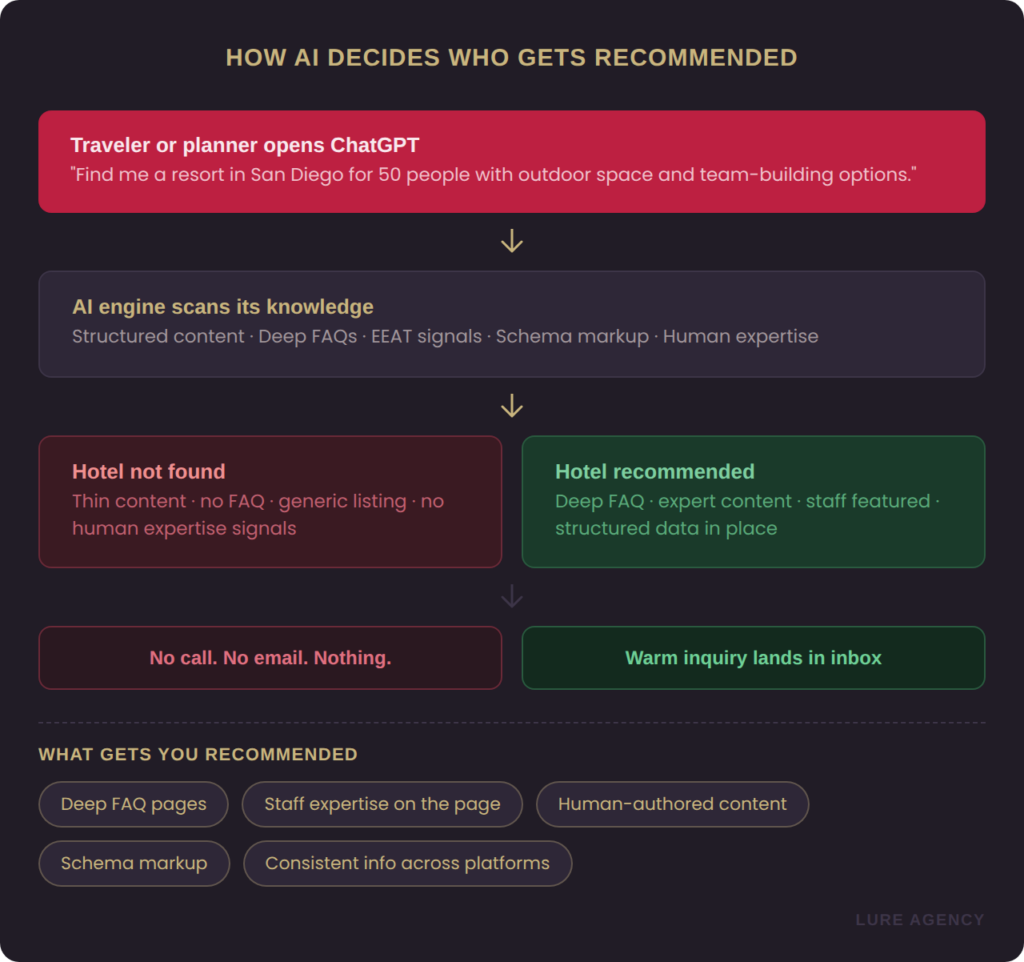
They’re typing things like: “I need a resort in San Diego for a 50-person corporate retreat with outdoor space and team-building options.” And ChatGPT is handing them a curated shortlist in seconds.
If your hotel isn’t on that list, you don’t get a call. You don’t get an email. You get nothing.
Craig said, “What previously took months of research, they’re getting it now within minutes.”
The toughest part of this for hotel marketing teams? They have no idea this is happening because they’re watching Google Analytics — not monitoring what AI engines say about them.
The Cheapest Fix With the Highest Return
I know what you’re thinking. There’s a $500-a-month tool for this, right?
Wrong. The highest-leverage move you can make right now costs nothing but attention.
Here’s the exercise Craig walked through in a workshop I heard about (and honestly, I’ve done this myself more times than I can count).
Open ChatGPT. Type: “I’m a wedding planner looking for a resort in San Diego. What would you recommend?”
See what comes back.
Odds are, your hotel isn’t number one. Maybe it’s not even on the list. So you follow up: “My resort has some great options. Why did you recommend those properties over mine?”
And ChatGPT will tell you. Exactly. Why.
“You’ll find you had a prompt but never looked at it that way,” Craig said. “You have these really cool, attractive offerings. You’ve never talked about them.”
That’s the insight. That’s the gap. And it points directly to the fix.
Build the FAQ Page Your AI Overlords Actually Want
My number one recommendation — and Craig and I landed on this independently in real time — is to build a deep, detailed FAQ page for meetings and events.
Not surface-level fluff. Not “How do I get to your hotel?” Nobody is asking ChatGPT that.
I mean the questions that planners, professional and non-professional, are actually typing into these tools right now.
-
What is attrition and how do you handle it?
-
What AV is included vs. rented?
-
Can your spaces be reconfigured mid-event?
-
What does a team-building day actually look like on your property?
-
What are your food and beverage minimums?
What most hotels get completely wrong is the EEAT principle. Experience, Expertise, Authoritativeness, Trustworthiness. These are the trust signals AI engines are hungry for. And no amenity list in the world will feed them.
They’re built from humans.
That means putting your sales team front and center.
Your director of events explaining how your property handles a 200-person hybrid conference.
Your catering manager writing about managing complex dietary requirements for a board dinner.
That content isn’t just good marketing. In the AI era, it’s discoverability infrastructure.
The shift I keep pushing our hotels on is moving away from product-centric selling, you know, the empty ballroom with chairs and an AV setup, toward people-centric selling. The team member using the space to help a planner pull off something extraordinary.
That’s the trust signal. That’s what gets you recommended.
Being Found Is Table Stakes. Being Recommended Is the Win.
There’s a real difference between appearing somewhere on an AI-generated list and being recommended with conviction.
“When you’re getting recommended,” I told Craig, “there’s a sense of wow. It’s almost like curated reviews. There’s a perception that the AI recommends these properties based on something.”
And that perception is powerful.
When ChatGPT tells a planner, “Here are five properties for your executive retreat and here’s why each one fits your criteria,” it has collapsed the entire consideration phase. The planner isn’t just browsing options. They’re receiving a trusted recommendation, complete with pros, cons, and context.
No banner ad has ever done that. No third-party listing has ever done that.
This is also why being recommended matters more than simply being found in the traditional RFP sense.
Planners used to submit an RFP and wait. Days. Sometimes weeks. Amazon killed that patience. Nobody waits anymore. AI gives them the answer now, and the hotels with the strongest trust signals get served up first.
One technical note worth flagging: structured data and schema markup.
Craig touched on it briefly, and I won’t drag you into the weeds here, but making sure your content is tagged and organized in a way that AI engines can actually read and retrieve is the difference between existing on the web and being discoverable on it. It’s a conversation worth having with your tech team or agency.
One More Thing: Clear Your Chat History Before You Spy On Yourself
Before you go run that ChatGPT exercise on your own property (and you should, today) clear your memory first.
AI models personalize responses based on your prior conversations, preferences, and behavior. If you’ve been using ChatGPT regularly, it already knows your vibe. Ask it to recommend a hotel without clearing that context, and you’ll get a flattering, personalized answer that tells you nothing useful about how a cold prospect experiences the same query.
“Chat loves to placate you,” I said on the show.
And I meant it. It’ll tell you you’re brilliant, your hotel is incredible, and your meeting spaces are world-class. Great for the ego. Useless for strategy.
Start fresh. Use an incognito window. Ask as a stranger would ask. That’s the signal worth paying attention to.
The Hotels That Move Now Win the Decade
The smartphone parallel isn’t rhetorical. It’s a warning.
Hotels that ignored mobile optimization in 2010 spent five years playing catch-up while competitors locked in the traffic. The ones that moved early built advantages that compounded.
This is that moment. Compressed into months, not years.
The ask isn’t overwhelming: run the ChatGPT audit on your property today, build a deep FAQ page, surface the humans behind your hotel’s expertise, and make sure the technical foundations are doing their job. Repeat next quarter.
The hotels showing up in AI recommendations right now aren’t necessarily the biggest brands or the biggest spenders. They’re the ones whose content is specific, human, and structured enough for an AI engine to trust.
That can be you. But only if you stop watching the wave and start paddling.
Want to Actually Win This? There’s a Method for That.
Everything I’ve laid out in this post: the website as a revenue engine, the intel on who’s actually searching, the nurture content that builds trust, the sales approach that doesn’t make planners cringe, that’s not a checklist. That’s a system.
It’s called the WINS Method™. And it’s exactly how we help hospitality teams show up, get recommended, and close more group business without throwing spaghetti at the wall.
Website. Intel. Nurture. Sell.
Built for hotel marketers and sales teams who are done guessing and ready to execute with a strategy that actually holds up in the AI era.
Learn more about the WINS Method™ →