
Blog
Central America Road Trip – Explore! Central America Highlights


I set out on a trip to Central America for a very particular reason. I had already been to Costa Rica and Guatemala, but I had never been to Nicaragua, El Salvador, or Honduras, and I liked the idea of filling in those blank spots on my map in one overland journey. The Explore! Central America Highlights (Reverse) was a 15-day small group trip that ran from Costa Rica to Guatemala, with stops in all five countries along the way. It was not a slow travel trip. It was the kind of trip where you keep your suitcase half-packed, where border crossings and road days are part of the story, and where each country gets just enough time to leave you wanting more.
That was also part of the appeal. Central America has a way of packing a lot into a small space. In just over two weeks, I moved from cloud forest to crater lakes, from colonial plazas to mangrove channels, from Mayan weaving demonstrations to ancient ruins, and from one volcano to another until it became a running joke.
Why This Trip Worked So Well
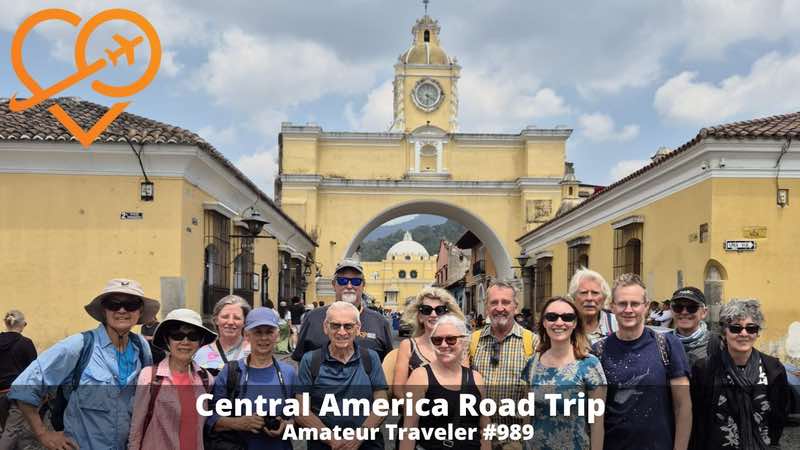
I found this tour while comparing several small-group itineraries on Tour Radar. The one I chose was slightly shorter than the alternatives, and it also included two places in Guatemala that I had especially wanted to see, Lake Atitlán and Antigua. It also offered a private room option, which, after enough years of travel, has become a luxury I appreciate more than I used to. The group itself turned out to be full of very experienced travelers, many of them country counters like me.
Costa Rica

San José Cathedral
San José
We began in San José, a city I had never really prioritized on previous visits to Costa Rica. This time, though, we toured the old colonial center, visited the market, saw the cathedral and the theater, and came away thinking I had probably been too quick to dismiss it. It was not the most memorable stop of the trip, but it was a good reminder that capital cities often deserve more grace than travelers give them.
Monteverde
From San José, we headed to Monteverde, the one stop on the trip I had visited before. Monteverde is one of those places that works well for first-time visitors and repeat travelers alike. It is easy enough to navigate, developed enough to be comfortable, and wild enough to remind you why Costa Rica became such a magnet for nature tourism in the first place.


One of the included activities was a night walk on a private reserve on the drier side of the mountain (the Pacific side). We saw tiny frogs, leaf-cutter ants still hard at work after dark, nocturnal birds sleeping in place, and one of the strangest insects of the whole trip, a headlight click beetle whose glowing spots made it look oddly alien, as if someone had designed a beetle for a science fiction movie. The scorpions were nearly invisible until the guides shone a black light on them, and suddenly they glowed with eerie clarity in the dark.

The next morning, we visited the cloud forest itself. The trail was wet, muddy, and wrapped in cloud, which is a poetic way of saying there were no grand views from the divide that day. Still, the forest had its own drama. Suspension bridges crossed through dripping greenery, birds flashed in and out of view, and monkeys turned up just often enough to keep everyone looking into the canopy.
Monteverde is also one of those rare tourist towns where the optional activities could easily fill several extra days, from ziplining to canopy walks to sloth visits. I had done some of those on a previous trip, so this time I was content to soak in the atmosphere and let Monteverde simply be Monteverde.

Palo Verde National Park, Costa Rica
The last Costa Rican stop before the border was Palo Verde National Park, and that ended up being one of the strongest wildlife experiences of the trip. A boat ride through the river channels gave us crocodiles, iguanas, howler monkeys, white-faced capuchins, and a long list of birds that delighted the birders in the group and impressed even the rest of us.


Costa Rica is often marketed through charismatic mammals, but birdlife is one of its great strengths, and Palo Verde made that abundantly clear.
Nicaragua
Crossing into Nicaragua added a layer of logistical drama to the journey. Our guide handled border fees and driver tips through a pooled tip kitty, which simplified things. More unusually, some travelers had to ship camera equipment and binoculars ahead because Nicaragua had become sensitive about professional-looking gear. That is the sort of practical complication you do not always see in the glossy brochures, but it matters if you are traveling with serious equipment. At customs, I emphasized that I am retired rather than a travel journalist, as I might not have been allowed into the country with “journalist” listed as my occupation.
Granada
Once inside the country, though, Nicaragua quickly justified the trouble. What struck me first was how visually dominated the landscape is by volcanoes. I knew, in a general sense, that Nicaragua was volcanic. I had simply not internalized what that looks like in daily travel. On the Pacific side of the country, volcanoes seem to be the backdrop of every photo.

Granada was one of my favorite cities on the trip. It is colorful, walkable, and full of weathered colonial beauty.
Mombacho Volcano
We climbed Mombacho Volcano above the city, first by bus and then in a truck that turned the ascent into its own adventure. The road was so steep that the ride felt like part off-road excursion, part amusement park attraction.

At the top, we got lucky. Usually clouds block the view, but on our day the sky opened enough for us to look down over Granada and Lake Nicaragua. It was probably the prettiest single view of the whole trip.

We hiked around the caldera of the volcano. The hike itself was memorable not just for the panorama, but for the contrast between the view outward and the life inside the caldera. Tropical plants thrived within the old volcanic bowl, giving the volcano an unexpectedly lush interior.

Las Isletas de Granada


Granada also offered one of the more interesting boat rides of the journey, this time through the small islands formed when volcanic material entered the lake from an eruption of Mombacho. The area was a lush habitat for birds, including the Jacana, called the “Jesus bird” because it appears to walk on water, and the Montezuma Oropendola, which builds nests that hang from trees.

Some islands held humble homes and fishing life, while others showed off the mansions of wealthy owners. That contrast, modest local life beside luxury retreats, seemed to say something about the region without ever spelling it out.

Masaya Volcano
And because one volcano was not enough, many of us added an evening visit to Masaya Volcano. We went at dusk, learned more about Nicaraguan volcanic history in the museum, and then approached the crater rim after dark. A collapse inside the volcano meant we could not actually see the lava, but we could see the orange glow rising from below, which was still dramatic enough to make the detour worthwhile.

Managua
On our way to our next stop, León, we made a brief stop in San Juan de Oriente, known for its ceramics, and at a vista point overlooking a crater lake, Laguna de Apoyo. Then we drove to the capital, Managua, where we made a quick visit to a viewpoint above the city, the ruins of the old cathedral (destroyed in the 1972 Managua earthquake), the old palace, and the malacon.

All around Nicaragua, you will see a major art project with stylized “trees of life” wired with lights to illuminate at night. But Managua in particular has a forest of these trees.

León
León, our next major Nicaraguan stop, made a sharp contrast with Granada. Granada felt polished and picturesque. León felt more political, more intellectual, and more layered. The city tour focused on revolution, the Sandinistas, and Nicaragua’s history of resistance and conflict. Even architecturally, León played differently. Some buildings looked unremarkable from the street, but opened into beautiful courtyards inside. It was a city that made you work a little harder for its beauty.

Cerro Negro

I skipped the popular, optional hike up Cerro Negro volcano. Many tourists sandboard down its steep, rocky, black ash slopes, but Explore!’s insurance company forbids that on their trips because of the danger. The group that hiked the volcano enjoyed it but found the 600 mph winds at the top a bit challenging.

Juan Venado Nature Reserve
Instead, I took the excursion to Juan Venado Nature Reserve, which meant another boat ride and another reminder that this trip was excellent for birdwatching again. Red and black mangroves framed the waterways, herons and egrets lined the edges, and we spotted a wonderfully camouflaged bird (the stick bird) that looked so much like part of a branch that I would have missed it completely without the guides.

American pygmy kingfisher
We saw a number of birds, including
- American pygmy kingfisher
- Magnificent frigatebird
- Brown pelican
- Royal terns
- Snowy egret
- Common potoo
- Black-necked stilt
- Great blue heron
- Little blue heron
- Great egret
- Great blue heron

For photographers, birding from a moving boat is always part patience and part luck. For travelers in general, it was simply a peaceful and beautiful morning.

Boat to El Salvador
We left Nicaragua by boat to avoid the long land route through Honduras. This also gave Nicaragua customs officials one more chance to look through our suitcases. They found my small binoculars, but were not concerned with them.
El Salvador

La Unión
If Nicaragua was the most visually dramatic part of the trip, El Salvador may have been the most surprising. I came in with an outdated mental image of the country, one shaped by years of grim headlines. What I found was a destination that had changed rapidly, with lower crime rates than in Canada. That does not erase the country’s difficult history, but it does mean travelers may need to update their assumptions.
We entered by boat at La Unión, which was hot, low, and tropical. This trip really did require packing for multiple climates. Sweatshirts, rain gear, long pants, and shorts all earned their place in the bag. That kind of range is one of the underrated challenges of a multi-country itinerary through Central America.
Most of the group went out to a community pupusas dinner that night, but I chose that night to catch the virus going around the group.

Suchitoto
From the coast, we continued to Suchitoto, a colonial town above a reservoir that immediately struck me as a place worth returning to. It had charm, a strong setting, and enough layers of history that it felt like we were only scratching the surface. This was one of several places on the trip where I found myself thinking, yes, I am glad I came on this fast-moving itinerary, but I would also like to come back and stay longer.
Cinquera

A visit to the village of Cinquera brought the country’s civil war history into focus. The village had been depopulated during the conflict, and the violence that unfolded there still shaped how the place is remembered. Yet it was not only a story of loss. Because people had been gone for years, nature had reclaimed part of the area, and what had once been a war zone also became a refuge of forest, trails, and swimming holes. That combination of painful history and renewed landscape made Cinquera one of the more thoughtful stops on the trip.

Part of the group took an indigo dying class and brought home tie-dyed scarves.

We took a boat ride on the lake near Suchitoto, and while some travelers had been put off by reports of trash along parts of the shoreline, I thought the outing was worth it. At one point, we watched wave after wave of cormorants pass overhead, one of those strangely mesmerizing wildlife moments that no brochure can really promise but that stays with you anyway. We saw motmots, vultures, herons, flycatchers, and other birds that by this point had made the trip feel almost accidentally designed for birders.
Guatemala

Esquipulas
We traveled to Honduras via Guatemala, making a quick stop in Esquipulas to see the Cathedral Basilica of Esquipulas, home to the Black Christ. We met a number of Mayan tourists making a pilgrimage to this significant site for local catholics.
Honduras

Copán
Honduras was the shortest stop of the trip, really just Copán and its surroundings. Still, it was enough to understand why travelers cross the border from Guatemala just to see these ruins. Copán is not the biggest Mayan site, nor the one with the tallest pyramids. What distinguishes it is the carving. The stonework has a richness and intricacy that makes the site feel more intimate and more detailed than some of the larger ruins elsewhere in the Mayan world.

The ruins were also alive with scarlet macaws, birds so bright they look almost unreal in flight. Even before I understood the site historically, I was already happy I had come just for the birds. Then the guide added the deeper context: Copán had roots going back as far as 1500 BC, rose to prominence in the Classic period, and was largely abandoned by the early 10th century.

Copán town itself was also pleasant, tourist-friendly, and easier than I expected. Border crossings on this trip were generally smoother than I had feared, and Copán felt almost like an extension of the Guatemalan travel circuit, just across the line. Even in a single night, it made an impression.
Guatemala
After Honduras, the pace quickened. We crossed back into Guatemala, spent a short stop in Guatemala City, then continued to Lake Atitlán, Chichicastenango, and finally Antigua. It was the most compressed part of the itinerary, and the one where I felt the tension between seeing a lot and seeing deeply most clearly.

Guatemala City
Guatemala City surprised me. I had not expected it to feel as modern as it did, with skyscrapers, American chain restaurants, and a polished urban feel in the district where we stayed. It is not that the city suddenly became the highlight of the trip, but it again reminded me that capitals are often more nuanced than travelers assume. We did a very quick visit to the central square and the cathedral.

Lake Atitlán
Lake Atitlán, on the other hand, was exactly as beautiful as I had hoped. Reaching it involved a drive up and over the crater rim and then down toward the lake, and that approach heightened the sense of arrival. This is not a lake that gradually appears. It reveals itself with a certain drama, framed by volcanoes and ringed by communities that each seems to have its own identity.

We crossed the lake by boat and visited San Juan La Laguna, which is a touristy town with a colorful shopping street filled with tourists and tuk-tuks that climbed up the hill away from the Lake.

As part of the tour, we saw a Mayan weaver demonstrate the backstrap loom and the use of natural dyes. Dyes were made from seeds, barks, and cactus bugs.
From there, we continued to Santiago Atitlán, with its market and more local feel, before ending the day in Santa Catarina. It all felt a bit rushed, and Lake Atitlán was probably the place where I most wanted another full day. On a longer trip, I would happily spend extra time exploring the lakeside towns, taking more boat rides, and simply watching the light change over the water and volcanoes.

Chichicastenango
Chichicastenango was next, famous for its market. I had been warned to expect chaos, but after traveling in other busy markets around the world, I found it less intimidating than advertised. It was certainly lively, with a mix of tourist handicrafts and everyday goods for local shoppers.

The part that interested me most was actually the brightly colored cemetery. Cremation is illegal in Guatemala, so cemeteries like this are crowded with a combination of graves and small mausoleums.
Inside the cemetery, we saw local Mayan people performing remembrance ceremonies involving candles, fire, and offerings. It revealed a side of local spiritual life that felt more compelling than the market stalls themselves.

Antigua
Then came Antigua, the final stop and one of the most photogenic cities on the trip. Antigua is beautiful in the way some old cities are beautiful because history has been both harsh and strangely preserving. Earthquakes damaged and emptied parts of it, and the ruins left behind became part of the city’s identity. Walking its cobblestone streets, passing churches and convents in various states of repair, I understood why so many travelers fall for it immediately.

I happened to be there during Lent, and that added another layer. Purple cloth hung in churches, and stations of the cross appeared around town.
In Antigua Guatemala, the Lent murals are usually called alfombras, meaning carpets. They are not wall murals, but elaborate temporary designs laid out on the streets for Holy Week processions or in churches.
They are made from materials like:
- dyed sawdust
- flowers and pine needles
- fruits and vegetables
- seeds
- colored sand or other natural materials
One evening after dinner, we encountered a procession moving through the streets. A large float was carried by hand, rocking slightly as it advanced, surrounded by the atmosphere of ritual and community that makes travel during a religious season feel different from visiting the same place at another time of year. Antigua would be beautiful at any season, but it was especially memorable then.

What Stayed With Me
This was not the ideal trip for people who want to unpack once, spend four nights in every destination, and linger over long afternoons in cafés. It was a road trip in the truest sense, a survey of a region, a fast-moving introduction with just enough depth to show what deserves another visit. Yet that is exactly why it worked for me.
Costa Rica felt polished and nature-forward. Nicaragua felt volcanic, dramatic, historically layered, and politically complicated. El Salvador felt like the surprise of the trip, a place on the ascent. Honduras offered a focused archaeological payoff at Copán. Guatemala brought together Mayan culture, dramatic landscapes, and one of the most attractive colonial cities in the region.

And through all of it, there were birds, boats, colonial plazas, changing climates, and volcanoes, always volcanoes. The image I return to most is still the view from Mombacho, looking down on Granada and Lake Nicaragua, a rare, clear day giving me the prettiest scene of the journey.
For travelers who want breadth, who enjoy seeing patterns across borders, and who do not mind a brisk pace, this kind of itinerary is a wonderful way to experience Central America. It will not satisfy every curiosity. In fact, it may create more of them. But that may be the best reason to go.