
Blog
The Complete Guide to Maasai Mara National Reserve, Kenya

One of my all-time favorite African safari destinations is the exquisite Maasai Mara National Reserve in Kenya. For me, this is the perfect place to come face-to-face with the authentic wilderness of Africa, and it’s where I’ve had many of the best game sightings out of all my African safaris. I’ve been to the Maasai Mara several times, and the high density of wildlife and superb sightings that come with it will no doubt keep drawing me back.
The Maasai Mara is known for the legendary Great Wildebeest Migration and is home to all of the Big Five (lion, leopard, elephant, rhino, and buffalo). Renowned for exceptional predator sightings, the Maasai Mara has particularly high concentrations of lions, leopards, and cheetahs. For instance, the reserve and surrounding conservancies have an incredible lion density of roughly 17 lions per 40 square miles (100km2). That’s significantly higher than most wildlife reserves in Africa, which means that if you’re hoping to witness the majesty of a pride of lions on the hunt, there’s really nowhere better to go than here.
In this article, I’m going to provide you with everything you need to know about planning your own visit to the Maasai Mara.

hartebeest
Which Part of the Maasai Mara is Best to Visit?
The Maasai Mara ecosystem is relatively compact. It’s an extremely biodiverse area that includes the Maasai Mara National Reserve (managed by the government) as well as many private conservancies (owned and managed by the local Maasai people) that surround the reserve. The total conservation area in this ecosystem amounts to approximately 580 square miles (1510km2).
You can think of the Maasai Mara as having three main parts: the first is the actual National Reserve, which is managed by the Narok County Government. This is by far the most popular part to visit. There’s just a handful of lodges within the national reserve, with most visitors staying just outside in either Sekenani or Talek. Then there is the Mara Triangle, which is to the west of the National Reserve and is managed by Mara Conservancy. It’s government-run again, but has slightly more restrictions than the main reserve. It’s the best place to catch the great migration river crossings.
And finally, there are the many private conservancies surrounding these areas, such as Mara North, Olare Motorogi, Naboisho, and more. Private conservancies are managed completely differently from the main reserve and the Mara Triangle. There’s a strict 5-car vehicle limit at sightings, and you’re able to go off-road to get closer to wildlife.
You’re probably wondering which area is best for you.

tented camp
If you’re a budget-conscious traveler, you’ll want to stick to the main National Reserve since lodging rates are significantly lower than in the private conservancies. Being able to stay just outside the park allows you countless lodging options, with something for every budget. Park fees are similar for the main reserve and private conservancies.
Private conservancies offer a more exclusive experience. There are fewer vehicles on the road, and off-road driving, night drives, and even walking safaris are possible. Visits to private conservancies are more expensive than the National Reserve, but if you want an off-the-beaten-track, peaceful, and intimate experience of the bush, this could be a great fit for you.
I’ve visited both the main reserve and a private conservancy (Mara North). As there are no fences between each reserve, wildlife can move freely, and the animal densities are similar. You’re therefore likely to see similar species in each.
Where the experience was totally different was the quality of the sightings. Not having to contend with dozens of vehicles at sightings in Mara North meant that I got to spend more quality time with the animals, and being able to go off-road meant we could stay with them, even when they journeyed deeper into the bush.
All in all, you’ll have amazing sightings in all three areas, and which you choose largely comes down to budget. There’s a reason that the Maasai Mara is consistently the highlight of visitors’ Kenya safaris.

The Great Wildebeest Migration
An undisputed highlight of my time in the Maasai Mara has been the absolutely epic, and aptly named, Great Wildebeest Migration. During this year-round migration cycle, over 1.5 million wildebeest, plus hundreds of thousands of zebras and gazelles, travel a whopping 800 miles (1000km). That’s around 2 million mammals all crossing vast savannahs and the raging Mara River. This journey is a clockwise loop that runs from the southern Serengeti in Tanzania, through the Maasai Mara, and back again, and takes a full year to complete.
It’s hard to wrap one’s head around those figures, but even more staggering is that an estimated 250,000 journeying ungulates (large mammals with hooves) actually die during each migration cycle, due to predation, drowning, and exhaustion. The journey is, literally, a life or death matter for these creatures.
The herds arrive in the Maasai Mara from approximately mid-July to mid-October each year, and cross the Mara River several times as it winds through the reserve. The pinnacle of the migration is the main Mara River crossing at the border of Kenya and Tanzania, where the Maasai Mara meets the Serengeti.
This crossing is particularly dramatic due to the river’s steep banks, strong currents, and ample crocodile population.
I was blown away by the sheer drama of the crossings I’ve witnessed. The crossings can get so crowded with wildebeests as the herds can wait for hours on the river’s steep banks, just waiting for one brave soul to take the plunge. Then, as soon as one plucks up the courage, hundreds of wildebeest, zebras, and antelopes leap off the banks into the churning water. It’s a high-stakes moment for the herbivores, as the water is teeming with crocodiles, many of which won’t have had a decent meal in up to 12 months. It’s one of nature’s most marvellous spectacles.

What Wildlife Can You Expect to See in the Maasai Mara?
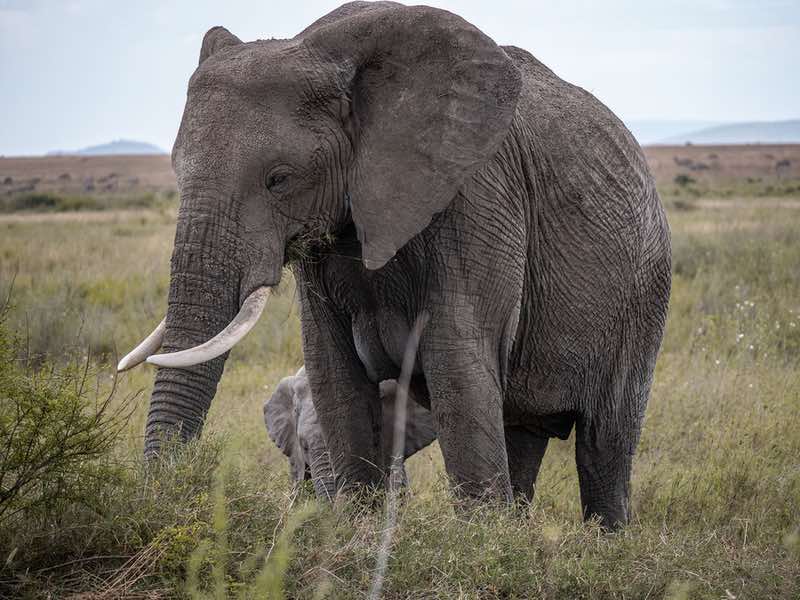
As spectacular as it is, the Great Wildebeest Migration is just one of many profound sightings waiting for you in the Maasai Mara. The Maasai Mara is also home to the Big Five: lion, leopard, buffalo, rhino, and elephant.
The Big Five earned this name from 18th and 19th-century trophy hunters visiting Africa, who deemed them the five most dangerous animals you can encounter on foot in the bush. Times have changed – all hunting has been banned in Kenya since 1977 – and today spotting all of the Big Five on a safari trip is considered a real accomplishment for visitors.
If seeing the Big Five is important to you, allow at least two full days in the Maasai Mara to give you the best chance of sighting them all. Lions, elephants, and buffalo are all present in high numbers. However, leopards and rhinos are a little trickier to spot, especially rhinos. On my first visit to the Maasai Mara, I managed to see all of the Big Five in three days.
Of all the Big Five, the rhino is definitely the hardest to spot due to its scarcity. Rhinos are critically endangered thanks to widespread poaching throughout Africa, and there are fewer than 60 black rhinos left in the whole of the Maasai Mara. I was lucky enough to watch one graze, which was extremely exciting not only for me but also for my guide. He explained that black rhinos are incredibly shy and solitary compared to their white rhino cousins, and spotting one in the open like this was a genuine rarity.

Cheetah cubs
In addition to the Big Five, the Maasai Mara is home to a number of special animals. It’s one of the best places in the world to spot cheetahs. On my first visit to the Maasai Mara, I was fortunate enough to see a mother cheetah and her four fluffy cubs. We stayed with them for some time as the cubs frolicked about and chased one another.
Other predators that you have a chance of spotting include hyenas, servals, and, if you’re lucky, the elusive caracal.

leopard
Best Time to Visit the Maasai Mara
On paper, the best time to visit the Maasai Mara is during the long dry season, which runs from June to mid-October. The weather is at its best with warm (but not too hot) days and minimal rainfall. This time of year also coincides with the arrival of the Great Wildebeest Migration.
If you do want to plan a trip to see the Migration, as many do, your best bet is to travel between mid-July and mid-October. This is the busiest tourist season in the Maasai Mara thanks to a few different factors. The great herds begin to arrive in mid-July, and weather conditions are dry, which generally means that wildlife sightings are easier because you don’t have to peer through too much vegetation to get a good view.
My favourite time to see the Great Migration is September – it’s a lot quieter than during the holiday rush of July and August, and there are still plenty of river crossings.
Traveling during this period does come at a premium, though: daily park fees for foreign visitors are $200 (US) per adult per day from July to December (even though the absolute peak-season busyness slows after October). Room rates for accommodation are also higher in the July – October peak season.
What many people don’t realise when planning a trip to the Maasai Mara is that even outside of the Great Wildebeest Migration, the area offers some of the best wildlife encounters in Africa year-round.
Accommodation prices start to drop after October. In the November “shoulder season” – also known as the “short rains” season – you can expect fewer crowds, lower prices in general, and excellent sightings. It’s a great time for photography enthusiasts and for those looking for a more exclusive experience.

baby giraffe
Another benefit of November and December is the abundance of baby animals. As the short rains arrive in late October, herbivores give birth. This is a fantastic time to see baby giraffes and zebras take their first steps. It’s also a reliable time to see predators hunting.
A particular highlight for me, on a visit in November, was seeing a baby giraffe running around on its long, wobbly legs, excitedly trying to keep up with its mother.
From January to June, park fees are half of their peak season rates, and come in at $100 per adult per day.
Although excellent wildlife sightings are possible in the Maasai Mara all year round, it’s worth knowing that during the quiet “long rains” of April and May, the weather is at its wettest and some camps are closed to visitors.
Where to Stay in the Maasai Mara
When it comes to places to stay in and around the Maasai Mara, you have hundreds of options. There are a few distinct regions, and each one tailors to slightly different budgets. Where you will stay will ultimately be determined by your budget.
Budget camps and lodges cost around $50 to $150 per person per night. Most budget options can be found near Ololaimutiek Village, to the southeast of the park. Enkorok Mara Camp is an example of a budget camp in this area.
Talek is slightly to the north of Ololaimutiek Village and is a great spot for mid-range lodges and camps ($200 – $300 per person per night). Zebra Plains is a favourite mid-range camp of mine.
There are no budget options within the national reserve itself. Serena Lodge is perhaps the most ‘budget-friendly’ option at around $300 per person per night. Most lodges within the reserve are luxury and fall into the luxury price bracket of over $500 per person per night.
The private conservancies that border the reserve only house luxury lodges. Prices are often upwards of $800 per person per night.
In my experience, you do get what you pay for when it comes to Maasai Mara accommodation, and the private conservancies do offer the most rewarding experience. That said, you can still have a fantastic time if you visit the main reserve. Talek is my favourite region to base yourself in if you have a tighter budget. It’s close to two different entrance gates and houses some lovely lodges.
If you’re combining your Maasai Mara safari with a trip to Serengeti in Tanzania, the location of your Maasai Mara lodge is important, as it can shorten the extensive 10-hour drive between the two parks. I’d recommend staying in Talek over Ololaimutiek Village, as this shaves at least an hour off the drive.

How to Get to the Maasai Mara
A crucial factor to be aware of in your planning is that self-driving is banned in the Maasai Mara, and has been since June 2024. That means that no matter what area you’re in, whether a national reserve or a conservancy, you can’t take yourself on a game drive in your own vehicle. You must use a licensed safari operator when inside the area.
Most visitors to the Maasai Mara arrive on an organized safari package that includes transport to and from the area. But I think it’s still a good idea to weigh up your inbound and outbound options before you travel.
There are two main ways to reach the Maasai Mara from Nairobi: a 5-6 hour drive or a short internal flight to one of several small airstrips.
If you’re driving, you’ll proceed via Narok town on the B3 highway and can stop at the Rift Valley Viewpoint en route. It’s a scenic drive, but can feel long and tiring, especially since the last stretch is unpaved.
If you’d rather avoid the extra driving, since you’ll be in a vehicle most of the time for your game drives, you can take a small bush plane from Nairobi to either Keekorok, Mara Serena, Ol Kiombo, or Musiara airstrips in about 45 minutes. Prices range from $300 to $1000 per person per flight, so this is a more expensive option than driving. However, it does save time, and you’re more likely to arrive at your destination feeling fresh and ready to start your safari. You’ll also get a bird’s eye view of the Maasai Mara.
When staying in a private conservancy, sometimes the only option is to fly due to the remote nature of the conservancies.
Practical Tips for Your Maasai Mara Safari
Last but not least, I’m going to share my top practical tips for a Maasai Mara safari trip. These are things I learned on my visits that you can’t possibly know without an insider’s perspective.
- If you’re staying outside the park, you can only enter the Maasai Mara once per day or else pay double the park fees. This means it isn’t possible to return to your lodge for lunch during the day, so make sure you enter the reserve with a packed lunch and plenty of drinking water. It’s a long day, but totally worth it!
- If you’d like a break from the vehicles, schedule an afternoon walk with an experienced ranger along the banks of the Mara River. This is a truly special way to experience the bush and allows you to see crocodiles and hippos very clearly.
- For a cultural fix, I recommend a cultural visit with the Maasai communities surrounding the reserve and conservancies, where you are likely to be treated to demonstrations of traditional Maasai dances. It’s a great way to support the local community.
- Malaria is present in the Maasai Mara, so I’d recommend speaking to your doctor before you go about which anti-malarial medication may be best for you.
- Pack clothes with neutral colours, especially avoiding black and navy blue, as these colours attract the biting tsetse fly.
- Layer up for cool mornings and evenings, with long sleeves and trousers to keep the mosquitoes away from your skin.
- A camera with a zoom lens and a pair of binoculars are an absolute must.

Conclusion
A visit to the legendary Maasai Mara is a once-in-a-lifetime experience (unless you get hooked, like me). This ecosystem delivers on every front, from the Great Wildebeest Migration to the Big Five to epic predator sightings. Add to that its astonishing natural beauty and one of the world’s most unique local cultures, and you have the makings of the most unforgettable trip.