
Blog
Your Manager Didn’t Promote You Because You Were Good.

She hit 140% of quota.
Three years straight.
She trained the new hires, cleaned up the messes, and stayed late when everyone else was already halfway to the car park. She was, by every measurable standard, the best person on the team.
She’s still a Senior Executive.
Her colleague — pleasant guy, never rocked the boat, never broke a record either — just got promoted to Sales Manager.
This isn’t a story from a movie. I’ve seen this exact scene play out in boardrooms, hotels, sales floors, and corporate corridors across three continents over 18 years. And every single time, the person left behind asks the same question:
“What did I do wrong?”
Nothing. That’s the uncomfortable answer nobody gives you.
You didn’t do anything wrong. You were just threatening.
The Promotion System Is Not Broken. It’s Working Exactly as Designed.
Here’s what they don’t teach you in any leadership programme or sales certification:
Most organisations don’t promote their best performers. They promote the people who make leadership feel most comfortable.
And those are two very different human beings.
The numbers back this up — hard.
Only 26% of workers are very satisfied with their opportunities for promotion. (Pew Research / high5test, 2025)
The overall promotion rate in 2025 is 10.3% — down from 12–13% in pre-pandemic baselines and well below the 14.6% peak of 2022. (Gusto Workforce Report, 2025)
82% of companies cite career progression as a key engagement issue — yet L&D budgets are still among the first to be cut when finances tighten. (Ravio Compensation Trends Report, 2025)
And perhaps the most damning stat of all: research published in Frontiers in Psychology found that men are promoted for potential, while women must demonstrate hard performance results first. That’s not perception. That’s documented, systemic bias.
The machine is working. Just not for you.
The S.A.F.E. Promotion Framework™
Why organisations consistently choose the wrong person — and what it costs them.
After nearly two decades of watching this pattern repeat itself in every industry I’ve worked in, I’ve broken it down into four real reasons why “safe” always beats “stellar” inside most organisations:
S — Status Quo Protection
High performers ask uncomfortable questions.
They challenge old processes. They point out inefficiencies. They push back when the strategy doesn’t make sense. And to a manager who has spent 10 years building those exact processes and defending that exact strategy — that is a threat, not an asset.
The “safe” candidate? They nod. They adapt. They say “let’s see how it goes.”
Leadership doesn’t promote talent. It promotes compliance dressed as reliability.
A — Affinity Bias (The “Like Me” Effect)
This one is rarely spoken aloud, but it operates loudly.
Research identifies 188 types of workplace bias. Among the most common in promotion decisions: Affinity Bias — the tendency to promote people who remind managers of themselves.
It’s not always malicious. It’s human. And it’s devastating to anyone who doesn’t fit the prototype the decision-maker has in their head.
The result? Homogeneous leadership teams that keep making the same decisions, in the same rooms, for the same reasons.
F — Fear of Being Outshone
Nobody in leadership admits this. But the data speaks for itself.
27% of workers would replace their manager if given the chance. (Nectar HR, 2025)
Why? Because many managers know, on some level, that the person they’re being asked to promote might eventually outperform them. And that realisation is terrifying if your own position isn’t secured by genuine performance — only by tenure.
So what happens? The manager gives the high performer a compliment, a slight salary bump, and a vague promise about “next cycle.” They promote the non-threatening option. And the high performer starts updating their CV.
E — Engagement Theater Over Real Output
Here’s what kills me most about corporate promotion culture.
Visibility often beats value.
The person who attends every optional meeting, laughs at the right jokes, and sends a weekly update email to senior leadership gets noticed — even when their numbers are average.
The person who closes the biggest deals, mentors three teammates, and drives real revenue? They’re “head down.” They’re “not strategic enough.” They “need to work on their executive presence.”
Translation: they don’t perform the right rituals. And in many organisations, ritual is confused with result.
The Before / After — What This Actually Costs
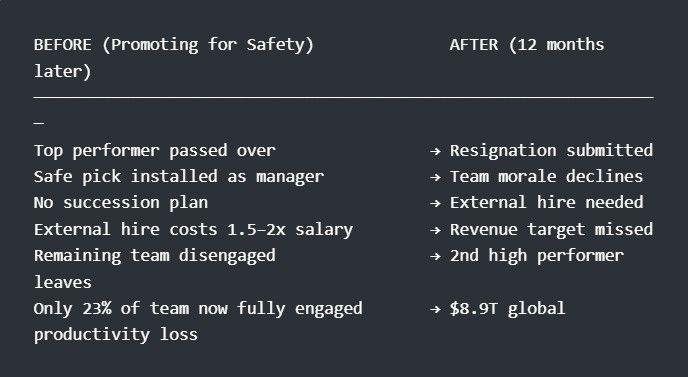
(Sources: Gallup State of the Global Workplace 2024; Gusto Promotion Data 2025)
This is not a talent problem. This is a leadership accountability problem with a direct line to your P&L.
The Tool: How to Protect Yourself Inside a “Safe” Culture
If you are a high performer working inside a system that rewards safety over results, here is what I have learned — and what I have taught to leaders I’ve mentored across the Middle East, South Asia, and global markets:
1. Make your output impossible to ignore. Visible work gets rewarded before invisible work. Document your wins. Share them intentionally. Don’t wait for your performance review — make the case continuously.
2. Build upward relationships before you need them. The calibration meeting where promotion decisions are made happens without you in the room. You need advocates who will say your name. Invest in relationships with decision-makers before the conversation happens — not after.
3. Be strategic, not just productive. High performers get trapped doing operational work because they’re the best at it. This is a ceiling, not a compliment. Push yourself into strategic conversations. Ask to be in the room. If the answer is no, ask why — and what it would take.
4. Know when the system is unfixable. Sometimes the organisation isn’t worth the performance you’re giving it. The most powerful decision a high performer can make is to take their excellence somewhere it will be recognised — not explained away.
What Great Leaders Do Instead
Here’s the contrast. I’ve worked with leaders who do this differently — and the difference in team performance, retention, and revenue is measurable.
The best leaders I know promote based on three non-negotiables:
-
Output over optics — What did you actually deliver? Not how often were you seen delivering it.
-
Potential over comfort — Does this person challenge the team to grow? Good. That’s exactly what’s needed.
-
Courage over compliance — Does this person say what needs to be said? That is the rarest and most valuable leadership trait of all.
When organisations build promotion cultures around these three principles, engagement climbs. Retention improves. Revenue follows.
It’s not a coincidence. It’s causation.
The Closing Truth
Disengagement at work now costs the global economy $8.9 trillion annually — that’s 9% of global GDP. (Gallup, 2024)
That number is not an HR problem. It is the compounded cost of every high performer who was passed over, underestimated, and eventually lost — to a competitor, to entrepreneurship, or simply to exhaustion.
The system will not fix itself.
But you can refuse to participate in it. As a leader — by changing how you promote. As a professional — by changing where you invest your excellence.
Stop asking what you did wrong.
Start asking whether the room you’re in is worthy of what you’re doing right.